

Turkey Interest Rate Cuts in 2026: A New Opportunity for Smart Investors?
How falling interest rates could reshape business valuations and create new investment opportunities in Turkey.
Turkey’s economy is entering a new phase. After years of high interest rates, rising operating costs, and financial pressure on business owners, the country’s monetary policy is gradually shifting.
For smart investors looking to buy a business in Turkey, this transition could create interesting opportunities.
But why do interest rates matter so much for business investments? In this article from Business Bey, we take a closer look at how Turkey’s changing interest rate environment could affect business valuations, influence investor decisions, and create new opportunities for those considering investing in the Turkish market.
Why High Interest Rates Put Pressure on Turkish Businesses
To control inflation, the Central Bank of Türkiye (CBRT) increased its benchmark interest rate to 50% in March 2024, making borrowing expensive and encouraging investors to keep their money in bank deposits.
Imagine running a restaurant, café, factory, or retail business in Istanbul. You manage employees, pay rent, handle suppliers, and take daily operational risks.
Meanwhile, another investor could earn attractive nominal returns by keeping a similar amount of capital in a bank, without the responsibilities of running a business.
This made business ownership relatively less attractive for some investors.
At the same time, high financing costs and weaker consumer demand placed additional pressure on existing companies.
Some businesses postponed expansion, while others struggled with rising expenses or began considering selling their operations.
However, a business facing financial pressure is not necessarily a business without value.
And this is where opportunities may begin.
Turkey’s Interest Rates Are Gradually Falling
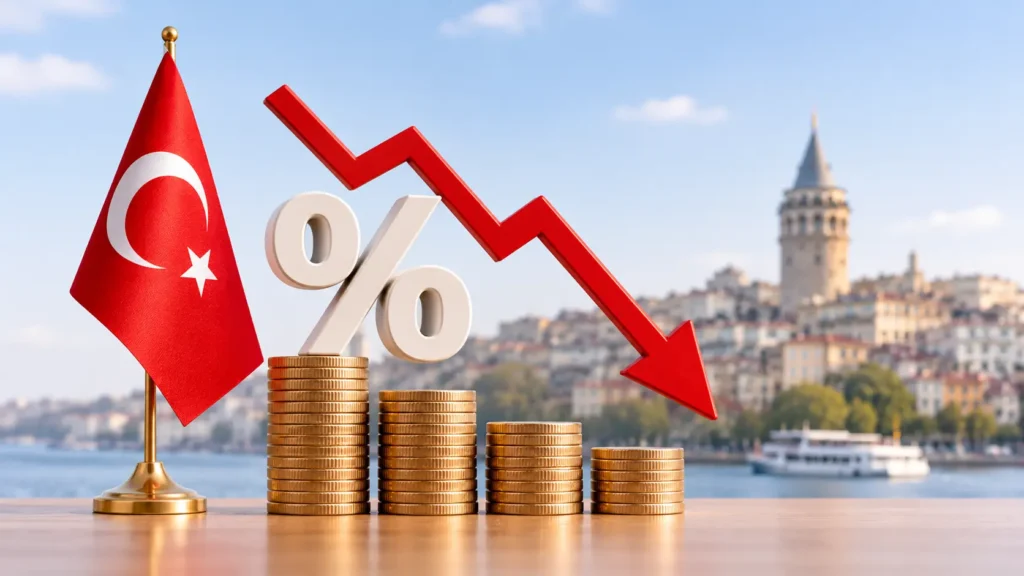
After reaching 50% in 2024, Turkey’s benchmark interest rate entered a downward cycle.
The policy rate declined to 38%, then to 37% in January 2026, and most recently reached 36% on October 22, 2026.
Further reductions may follow if inflation and economic conditions allow, although the pace remains uncertain.
As bank deposit returns gradually decline, some investors may redirect capital toward established businesses, commercial properties, and other income-generating assets.
This shift could increase demand for business acquisitions and potentially support higher valuations over time.
Why Falling Interest Rates Could Increase Business Values
Lower interest rates can influence business valuations in three important ways.
Lower financing costs
Businesses may find it easier to borrow, invest, expand, and improve their financial performance.
Growing investor demand
As deposit returns become less attractive, investors may explore alternative opportunities, including existing businesses and commercial properties.
Higher business valuations
Increased investor interest and lower required rates of return could support higher acquisition prices for profitable businesses.
Of course, falling interest rates do not guarantee rising business values. Inflation, profitability, currency movements, and overall market conditions remain important.
However, what investors are willing to pay for a business today may differ significantly from what they are willing to pay when economic conditions improve.
Why Some Business Owners Are Willing to Sell
After years of high operating expenses, expensive financing, and economic uncertainty, some Turkish entrepreneurs are ready for a change.
They may own businesses with established customer bases, valuable locations, experienced employees, and functioning operations, yet no longer wish to continue managing them.
As a result, certain owners may be willing to negotiate attractive acquisition prices.
For investors, this creates an opportunity to explore established businesses that may be offered below a reasonable estimate of their intrinsic value.
However, a low asking price alone does not make a business a good investment.
Identifying genuine opportunities requires financial analysis, market knowledge, and careful due diligence.
Is Now the Right Time to Buy a Business in Turkey?
Investors often face the same question during economic transitions:
Should I invest now or wait until market conditions become more stable?
Waiting may reduce uncertainty. However, improving economic conditions could also attract more buyers and increase competition for established businesses.
This is why experienced investors pay attention to economic cycles, acquisition prices, and long-term business potential.
The objective is not to predict the market perfectly, but to recognize opportunities supported by sound financial reasoning.
Smart investors don’t simply follow the market. They recognize potential before it becomes obvious.
Business Bey | Business & Investment Advisory
At Business Bey, we believe successful investments begin with the right information, the right opportunities, and a clear understanding of the market.
As Turkey moves through this economic transition, we help investors explore established businesses, evaluate acquisition opportunities, and navigate important commercial decisions.
Whether you are interested in acquiring a restaurant, café, franchise, hotel, or another operating business, our team is here to help you understand your options.
If you are considering investing in Turkey, connect with Business Bey to explore opportunities that match your goals.
Discover opportunities. Understand the market. Invest with confidence.
Frequently Asked Questions
-
How long will interest rates continue to fall in Turkey?
Further reductions may continue as inflation improves and the economy moves toward greater stability. Interest rates below 20% are a possible longer-term scenario, but there is no confirmed timeline.
-
Could interest rates drop suddenly?
Turkey’s central bank currently follows a cautious, data-driven approach. Gradual reductions may help limit economic disruption, although future decisions will depend on inflation and market conditions.
-
How could falling interest rates affect business investments?
Lower deposit returns may encourage investors to explore operating businesses, potentially increasing acquisition demand and supporting business valuations. The actual impact will depend on profitability and market conditions.
-
Which businesses could offer the most attractive opportunities?
Established businesses with strong fundamentals and owners motivated to sell may offer attractive opportunities, particularly when their asking prices are below carefully assessed intrinsic value.
